Improving access to routine healthcare among vulnerable communities in coastal North Devon
In Ilfracombe in North Devon, a new primary care outreach service in a community centre is improving access to routine healthcare assessments, including colorectal cancer testing, for residents at high risk of ill health and premature death.
In this blog, Dr Marie-Joelle West, Programme Manager at Health Innovation South West, and Andrea Beacham, Senior Programme Manager for Health Inequalities at One Northern Devon, share their work in partnership with One Northern Devon to improve access to care and better equity of health in Ilfracombe as part of NHS England’s national Innovation for Healthcare Inequalities Programme.
 Andrea Beacham: Ilfracombe is located in one of the most beautiful parts of the country, but its stunning coastline, bustling harbour, seafront and beaches mask the harsh realities of deprivation and health inequalities. Ilfracombe’s electoral wards are in the top 10% most deprived areas in England [1], and people living in Central Ilfracombe have a 15-year lower life expectancy than people who live in more affluent parts of Devon [2].
Despite the advantages of its natural environment, several factors are at play that drive these inequalities. A particular issue is housing. There is a lower percentage of social rented accommodation available in the town in comparison to the national average and 30% of all households live in privately rented homes [3]. Ilfracombe has a strong Victorian heritage but many of the large Victorian hotels and homes have been split into poor quality, privately rented flats resulting in more flats and fewer houses than the national average.
At Belle’s Place, a community hub on the seafront, over 200 locals with higher-than-average health needs are provided with a safe and nurturing place to eat a meal and socialise. Many have found their way to Ilfracombe through temporary housing by local authorities outside of the area, due to the relative availability of comparatively cheap accommodation, and therefore don’t have a strong network of family or social connections.
Around 30 of these individuals struggle to access healthcare via the traditional routes, and many are vulnerable and insecurely housed. They often lack access to mobile phones and credit, may not live at a consistent postal address, find it difficult to stick to fixed appointment times, or lack the disposable income needed to attend hospital appointments 15 miles away. These individuals are at higher-than-average risk of poor health, chronic illnesses including cancer, and lower than average life expectancy.
 Marie-Joelle West: For rural and coastal areas like North Devon and the wider South West Peninsula, where high levels of deprivation and barriers accessing care cause significant disparities in health, research and innovation is crucial. Health Innovation South West has partnered with One Devon to test a new person-centred, primary care outreach model in Belle’s Place to improve access to routine healthcare and cancer testing for its vulnerable community.
This partnership underpins Health Innovation South West’s delivery of NHS England’s national Innovation for Healthcare Inequalities Programme (InHIP), which is supporting local Integrated Care Systems to address local healthcare inequalities experienced by deprived and other under-served populations. Cancer testing is one facet of our InHIP programme in Devon, alongside improving access to innovations that reduce risk of cardiovascular disease (which you can read more about here).
Tackling testing together
Andrea: We know mortality rates caused by severe illnesses such as cancer are twice as high in areas of high deprivation, especially in coastal areas [4]. Delayed diagnoses among homeless and vulnerable individuals can happen for a variety of reasons. These individuals may struggle to schedule their lives around appointments; they may have mental health issues that can affect their ability to seek care or have had negative experiences of healthcare in the past; they may prioritise basic everyday living needs over potential health concerns, or have unhealthy coping mechanisms and lifestyles.
One type of innovation called a faecal immunochemical test (FIT) can help detect signs of colorectal cancer early in a non-invasive and cost-effective way. Currently, uptake of FIT is particularly low within vulnerable communities. Increasing uptake to FIT testing among these communities is a crucial step in reducing disparities in health and care, improving early cancer detection – and ultimately saving lives. Our work with Health Innovation South West is aiming to increase access to healthcare and uptake of interventions such as FIT testing for these population groups who regularly attend Belle’s Place in Ilfracombe, and who may not otherwise receive the care they need.
Piloting a primary care outreach service
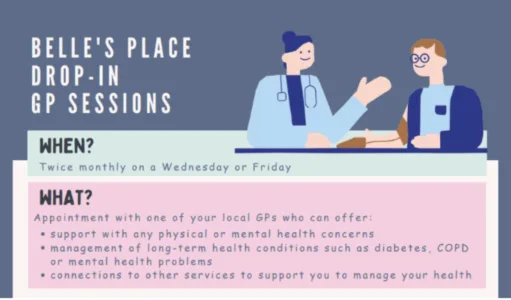
Marie-Joelle: We are piloting an outreach service delivered by a GP for a select group of individuals attending Belle’s Place café. Drop-in sessions are being held twice a month for people to receive routine care by GPs from Combe Coastal Practice and from the North Devon Coastal Primary Care Network wellbeing team. Before we began, the sessions were promoted by posters at Belle’s Place and leaflets distributed where we knew our target population group frequently visited. The Peninsula Cancer Alliance has been supportive of this innovative care model and is keen to share best practices further.
Andrea:
As well as FIT testing where appropriate, patients are offered other interventions including signposting for ongoing care and earlier identification of mental health difficulties and chronic diseases. The aim of the project is to test a way of ensuring vulnerable people living in Ilfracombe have access to a holistic and caring health assessment in a way that is accessible for them.
We want to understand the previous healthcare experiences of the people who attend Belle’s Place, as well as their experience of healthcare during the pilot. We have therefore planned time for the town’s Community Developer to carry out qualitative interviews with patients before and after their GP outreach appointment to collect real-life data on their experiences.
What we’ve learnt so far
Marie-Joelle: 30 patients have been seen to date at Belle’s Place and out of this group, four have completed the FIT test (with negative colorectal cancer results) amongst other health interventions. With optimised routine GP care, including signposting to ongoing care where needed, individuals attending Belle’s Place are now offered improved health outcomes and earlier identification and management of colorectal cancer, other cancers and chronic diseases such as hypertension, diabetes and chronic obstructive pulmonary disease (COPD).
Andrea: Developing trust and relationships has been at the core of the project. Prior to our outreach work, among the group attending Belle’s Place there was a general wariness of the ‘system’ and a feeling of being forgotten by society. Belle’s Place Director and Manager, Carol Parkin is trusted by those who attend and her encouragement to use the drop-in service was a key factor in its uptake.
Equally important is the desire of Combe Coastal Practice to work in a different way with this community and the passion of the individual GPs who volunteered to do the outreach clinics. It is the attitude of the GPs as much as the venue that has made the service accessible.
The Community Developer has also played a role in encouraging participation. For example, he suggested to one person that they had nothing to lose by attending a drop-in session. After the appointment, the person described the experience as “brilliant”, remarking that things were put in place and that action was being taken to address their issues. When people have had poor experiences of healthcare it can take a certain level of persuasion, and the support of those within communities who have already built these relationships is needed.
Another key learning that has emerged includes time pressures being a barrier to engagement with healthcare. Both in the initial call to the GP practice to make an appointment and during the appointment itself, individuals interviewed said they felt under pressure and found it difficult to explain themselves. The ability to see the GP without having to go through a gatekeeping process that they found stressful, and to have the time to discuss a variety of concerns with their GP, was a significant enabler and allowed the GP the time to explore underlying factors and not just the presenting issue.
It was very helpful. I spent about 45 minutes in there. He went through everything; he asked about problems. He went straight on to follow up. I had a response from the things that the doctor arranged for me within a week.
Feedback from a patient user of a GP drop-in session at Belle’s Place
There has been a palpable change in the group since [the outreach service] began. It hits you when you enter. There’s a change in how [the patients] engage; their head is held a little higher, they are more confident and happier. The way in which they discuss things or ask for advice has changed. It’s made a difference to their self-worth. I believe this will be a turning point; not for all but for some.
John Thornton, Community Development Officer, One Ilfracombe
Marie-Joelle: Surveys with the outreach and community teams are set to give us further insights into the enablers and barriers of delivering care to this group of patients. One emerging key enabler is a multi-disciplinary approach; by bringing together wellbeing, mental health, housing and literacy teams that are collaborating effectively, it has allowed more time to be spent reviewing patients than is usually possible during a GP consultation.
Informing a sustainable model
Andrea: We know from our health inequalities work at One Northern Devon and with people with multiple and complex needs, how important it is to offer person-centred services that are shaped to meet the needs of the individual. The challenge is that we tend to have a one-size-fits-all service that works well for a lot of people but leads to widening inequalities when it doesn’t meet the needs of people with multiple health conditions and complex lives. We need to be able to demonstrate that a person-centred approach is not only better for the patient but is the most efficient use of resources.
Work like this project at Belle’s Place can help us to understand if delivering care in different ways for different people reduces unscheduled care needs such as emergency attendances and admission to hospital. We hope that this work will help inform future commissioning, not only in the way healthcare services are approached for vulnerable groups – providing more flexibility and longer appointment times, for example – but also in relation to obtaining sustainable funding for small community organisations such as Belle’s Place that do vital work that ultimately benefits the healthcare system.
Marie-Joelle: At Health Innovation South West we are working to understand the barriers and enablers for people at high risk of health inequalities to access routine healthcare. For these people we want to improve access to health care services, improve the experience of routine healthcare, and earlier identification of chronic diseases.
Our work together at Belle’s Place is improving access to personalised healthcare, including earlier cancer testing, for underserved populations living in a rural and coastal locality. While the project runs for one year, we are currently supporting Devon Integrated Care System (ICS) with an evaluation of the pilot at Belle’s Place, to understand the components necessary for an effective GP outreach model within the community. We are also supporting Devon ICS to prepare a business case to sustain project benefits in North Devon and to spread them further afield.
Our increased understanding will inform sustainable service commissioning and provision in rural and coastal regions like the South West Peninsula, which face different challenges to urban areas. With an understanding of a local system and place, we can adapt innovative services to meet local needs.
Our ambition is to expand the model of using existing hubs or services that have built rapport and trust with communities, to drop-in sessions for routine care in other rural or coastal areas. We know it takes time, and enablers in place, for systems to adopt innovation into everyday practice. With further research mobilisation and evidence-building, systems can be supported to adopt and adapt this model for other harder-to-reach communities, to transform their access to care and their equity of health.
Marie-Joelle West presented the outreach project at Belle’s Place at the Royal Society of Medicine’s inaugural Tackling Inequalities Conference on 16 January 2024.
For more information about the project and its learnings please contact Marie-Joelle ([email protected]) and Andrea Beacham ([email protected]).
Health Innovation South West is working with seven local health and care organisations to establish the South West Peninsula as a leading research and innovation system focused on improving health in rural and coastal communities. We are working to improve the lives of people living with long term conditions, multiple conditions and frailty by partnering on a variety of programmes. Learn more about our Peninsula Research and Innovation Partnership.
References
[1] Devon County Council Strategic Plan 2021-25 Tackling poverty and inequality – Strategic Plan (devon.gov.uk)
[2] One Devon Partnership Integrated Care Strategy, June 2023 Devon Plan – including the Joint Forward Plan and Integrated Care Strategy – One Devon
[3] Office for National Statistics, Census 2021
[4] Chief Medical Officer’s Annual Report 2021: health in coastal communities Chief Medical Officer’s annual report 2021: health in coastal communities – GOV.UK (www.gov.uk)